
Quartz Epoxy Flooring: Decorative Industrial Floor Guide
Quartz (floating-sand) epoxy flooring explained: how it compares with mirror-smooth epoxy, what lab-tested strength and slip figures mean, and how it is installed. By ZHENG'OU.

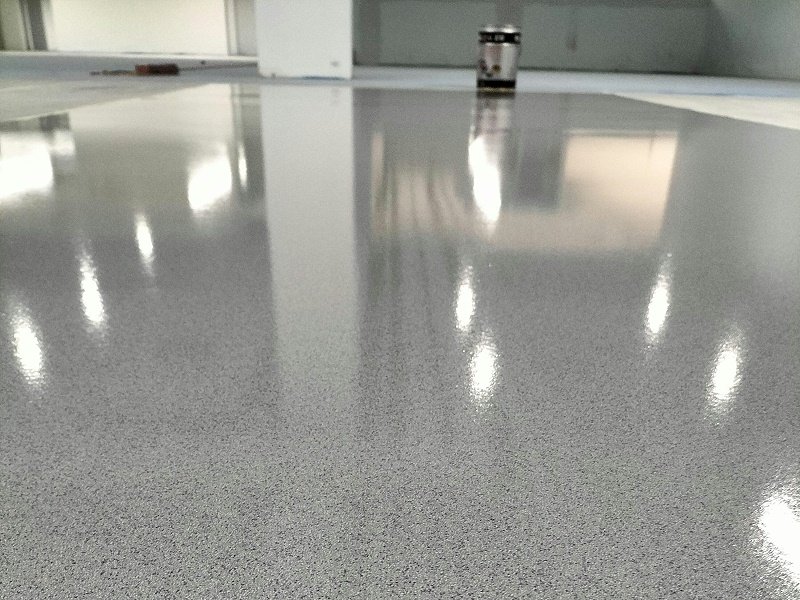
Two floors can sit in the same building, serve the same traffic, and cost the same per square metre — and still be completely different products. One is a mirror-smooth, single-colour epoxy surface that reads as "cleanroom". The other carries thousands of coloured quartz grains per square metre, hides scuffs and tyre marks, grips forklift tyres in the wet, and still looks like a design decision rather than an industrial afterthought.
The second one is what our catalogue calls floating-sand epoxy self-levelling — known internationally as quartz epoxy flooring, quartz broadcast flooring or resin quartz screed. It is a composite floor topping: coloured quartz sand locked into low-viscosity epoxy resin, finished with seal coats. In our group it is one of the three best-selling systems, and it is the system we specify most often where a client wants an industrial floor that visitors will actually see.
This guide is for the people who choose between those two worlds:
- Contractors who need to know how a quartz-filled system differs to install, and where it wins jobs that plain epoxy loses.
- Importers and distributors deciding whether a decorative-industrial line belongs in their portfolio.
- Architects, consultants and facility managers who need to justify a specification with numbers, not with samples alone.
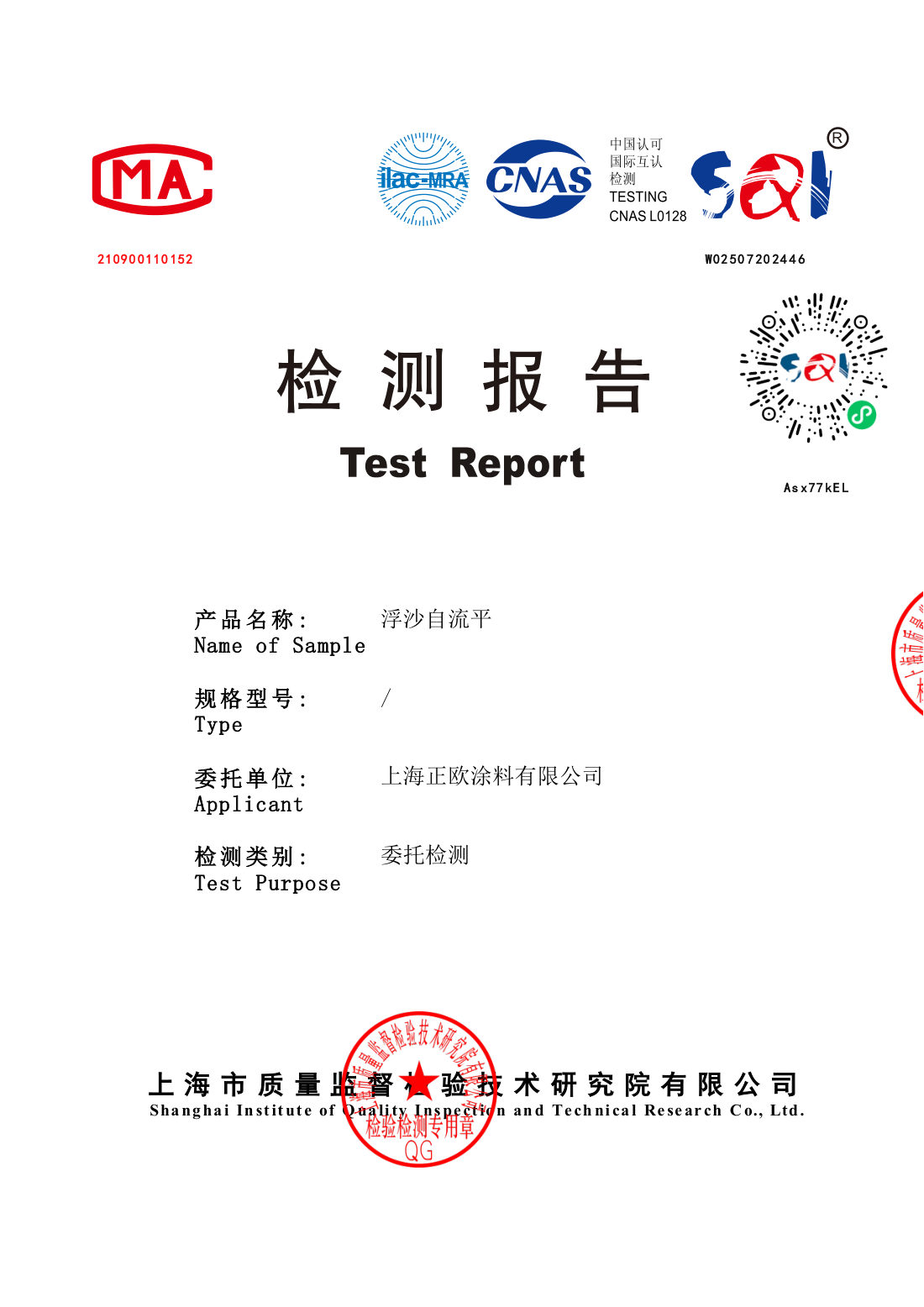
Everything quantitative in this article comes from one document we can hand you: test report W02507202446, issued by the Shanghai Institute of Quality Inspection and Technical Research, tested to the Chinese national standard for floor coating materials. We quote it in full, including what it does not prove.
Key takeaways
- "Floating sand" and "quartz epoxy flooring" are the same system family; the international search term is the latter.
- Our tested system measured 79 MPa compressive strength, 0.010 g abrasion loss, and a dry friction coefficient of 0.77 — each number explained below.
- The mixing ratio is A : B = 8 : 1 by weight, stated in the test report itself.
- Texture is a feature: it buys slip resistance and wear-hiding, at the cost of gloss and slightly harder cleaning.
- A commission test report proves what the sample did — not what every batch will do. Read it accordingly.
1. One System, Three Names
If you search for this floor type internationally, you will not find "floating sand". You will find:
- Quartz epoxy flooring / quartz broadcast flooring — the common North American term
- Resin quartz screed — the common UK and European term
- Epoxy terrazzo — a related but distinct system (we explain the difference below)
"Floating-sand self-levelling" (浮砂自流平) is our product name for the same family. It describes the construction method: graded quartz sand is worked into a low-viscosity, self-levelling epoxy matrix, so the sand appears to "float" in the resin rather than sitting on top of it. The result is a through-textured composite — the colour and aggregate you see are not a coating on the surface but part of the body of the floor.
This matters commercially, because it is the difference between a coated floor and a built floor. A coated floor wears from the top down; when the film is gone, the colour is gone. A quartz-filled composite wears the same way a terrazzo does — the aggregate continues through the wear layer, so the appearance survives years of traffic that would strip a paint film.
How it relates to epoxy terrazzo
Buyers often arrive at quartz epoxy flooring by way of terrazzo searches, so the boundary is worth drawing:
- Epoxy terrazzo uses marble or glass aggregate, ground flat and polished to a stone-like finish. Premium look, premium labour, premium price.
- Quartz epoxy flooring uses natural quartz sand, troweled or self-levelled and sealed — not ground to a polish. It keeps a matte-to-satin texture, costs less to install, and delivers most of the decorative effect.
- Mirror-smooth self-levelling epoxy uses no aggregate at all — pure resin, maximum gloss, minimum texture.
If you are comparing against poured terrazzo, quartz epoxy is the pragmatic middle. If you are comparing against plain self-levelling epoxy, the decision is about texture versus gloss — which is the subject of the next section.
Recommended reading: Floating-sand epoxy self-levelling → · Our guide to mirror-smooth epoxy self-levelling →
2. Quartz Epoxy vs Mirror-Smooth Epoxy: Choose by Texture, Not by Hype
These two systems share primers, share chemistry, and often share a price band. They are not competitors; they are answers to different briefs.
| Question to ask | Mirror-smooth self-levelling epoxy | Quartz (floating-sand) epoxy |
|---|---|---|
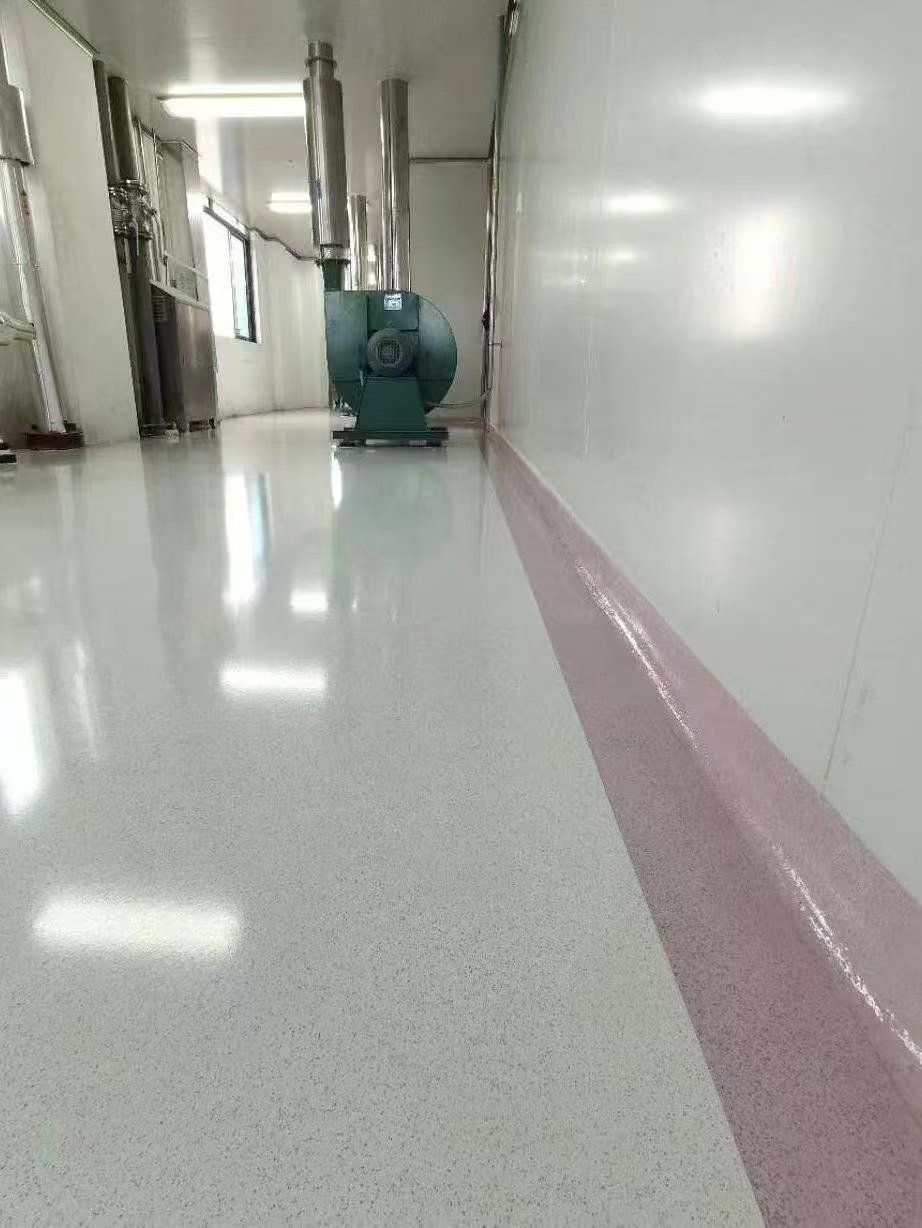
| What does it look like? | Single colour, mirror gloss, shows every reflection | Speckled, multi-colour aggregate, satin-to-matte |
| How does it wear? | Gloss dulls first; scratches show on a plain field | Wear blends into the aggregate texture; scuffs disappear |
| Slip behaviour | Glossy surface is slick when wet; needs an anti-slip add-on to be safe wet | Built-in micro-texture; our tested system measured a 0.77 dry friction coefficient |
| Cleaning | Squeegee and auto-scrubber glide over it; easiest to clean | Texture holds slightly more soil; needs mechanical brushing on a schedule |
| Substrate forgiveness | Gloss telegraphs every slab imperfection | Aggregate hides minor undulation and patching far better |
| Best brief | Cleanrooms, pharma, electronics — where cleanliness is the message | Showrooms, retail, lobbies, show areas, garages, heavy traffic — where appearance and wear share the brief |
That last row is the decision rule in practice. When the floor is part of the message — a pharmaceutical suite audited for cleanability, a wafer fab audited for particles — mirror epoxy is the right answer and texture is a liability. When the floor is part of the experience — a customer walking through your plant, a car showroom, a museum lobby — quartz earns its keep every single day, because it looks designed and never looks tired.
A secondary rule follows from the table: on an imperfect slab, quartz is the more forgiving specification. A high-gloss floor is a magnifying glass held over your concrete contractor's work. An aggregate floor is a diffuser.
Related systems: Solvent-free epoxy self-levelling → · High-solid epoxy topcoat →
3. What the Lab Numbers Mean — for Your Floor
Most suppliers publish a spec table; few explain what the numbers change on site. Here is ours, tested to GB/T 22374-2018 (Chinese national standard for floor coating materials) by the Shanghai Institute of Quality Inspection and Technical Research, report W02507202446, testing period 19 December 2025 – 6 January 2026.
| Property | Result | How to read it |
|---|---|---|
| Surface-dry time | 6 h (limit ≤ 8 h) | The window before the floor no longer accepts a following operation |
| Through-dry time | 24 h (limit ≤ 48 h) | When the floor can take controlled traffic; full chemical cure continues beyond this |
| Shore hardness (Type D) | 81 (measured value) | A hard, dense film; measured rather than pass/fail, which we explain below |
| Abrasion loss (750 g / 500 r) | 0.010 g (limit ≤ 0.030 g) | One third of the standard's allowance — the wear headroom that matters in traffic lanes |
| Compressive strength | 79 MPa (limit ≥ 45 MPa) | 75% above the standard's floor; this is where racking feet and point loads stop being a threat |
| Tensile bond strength | 4.0 MPa standard / 3.9 MPa after water immersion (limit ≥ 2.0 MPa) | The number that predicts delamination risk — and the fact that it barely moves when soaked is the part worth noticing |
| Impact resistance | 1,000 g steel ball: no cracking, no peeling | Dropped tools and falling parts, tested rather than promised |
| Dry friction coefficient | 0.77 (limit ≥ 0.50) | The slip-resistance number — explained in full in Section 7 |
| Water resistance (168 h) | No blistering, no peeling, no discolouration | A week of continuous exposure |
| Alkali resistance (20% NaOH, 72 h) | Pass, no change | Detergents and process alkalis |
| Acid resistance (10% H₂SO₄, 48 h) | Pass, slight discolouration | The one honest asterisk in the table — see below |
| Oil resistance (No. 120 mineral spirit, 72 h) | Pass, no change | Oils and solvents in workshop service |
Three numbers deserve a second look
Abrasion at one third of the allowance. Standards are written as ceilings — "lose no more than 0.030 g". Measuring 0.010 g means the system used a third of its budget. For a buyer, that translates directly into service life in forklift lanes, not into a certificate on a wall.
Bond strength that survives immersion. Most floor failures start at the bond line, and water is bond line's oldest enemy. A system that measures 4.0 MPa dry and 3.9 MPa soaked is telling you the interface does not depend on a moisture-sensitive film. That is a specification argument you can put in front of a consultant.
The acid asterisk. After 48 hours in 10% sulfuric acid the film passed — no blistering, no peeling — with slight discolouration. We print the discolouration because a sales table that quietly drops inconvenient detail is exactly the behaviour this article tells you to distrust in others. For splash-and-clean acid service, this system is suitable. For continuous acid contact, specify a dedicated anti-corrosion lining instead.
What the report does not prove
Three honest limits:
1. Hardness is a measured value, not a criterion. The report states Shore D 81 "as measured" — the standard does not set a pass/fail for this property on this product class. It is reference data, not a conformity claim. We would rather you knew that from us than found it out from the fine print.
2. This was a commission test on a submitted sample. The sample was client-submitted (2 kg, received 16 December 2025). It demonstrates what this formulation achieves — it is not a batch surveillance programme. For project batches, we support third-party witness testing.
3. The report says nothing about VOC or emissions. Performance and emissions are different documents against different standards — the same distinction we teach in our test-report guide, and it applies to us as much as to anyone.
Full scan of the report is published on the product page →
4. Where Quartz Epoxy Wins — by Environment
The headline use is commercial and industrial spaces where the floor is seen. Environment by environment:
Retail, showrooms and car dealerships. The flagship application. Multi-colour aggregate reads as a designed surface; vehicle traffic and stiletto heels do nothing to it; a 0.77 friction coefficient keeps entrances safe on rainy days. When a showroom floor still looks uniform after two years of footfall, that is the abrasion number doing its job.
Museums, galleries, airports and public buildings. Seamless, speckled, quiet underfoot, and able to carry rolling loads from trolleys to display crating. Aggregate texture also performs better than gloss under the mixed natural and artificial lighting of large public halls, where mirror floors produce visually noisy reflections.
Offices, lobbies and mixed-use commercial. Where a building wants "industrial-chic" without the maintenance contract of polished concrete or terrazzo.
Parking structures and garages. Tyre marking, oil drip, turning loads — and wet ramps. Quartz texture plus a 0.77 friction coefficient is the combination plain epoxy cannot offer without add-ons. Note the standard epoxy caveat: under sustained UV (open decks, daylight through openings) top surfaces yellow, so enclosed levels are the natural fit.
Industrial workshops and warehouses. Where impact, oil and point loads dominate. The 79 MPa compressive figure and 1,000 g steel-ball impact result are aimed at exactly this brief — though in pure heavy-industry briefs, our advice is often a heavier build-up with the aggregate in the body rather than a thin decorative topping.
Food and beverage, light manufacture. Splash-and-washdown service is within the tested envelope (water, alkali, oil all passed at the stated conditions). Where hygiene auditability is the dominant requirement, mirror epoxy or an HACCP-focused system remains the better first choice — the texture that hides wear also holds soil, which Section 7 addresses honestly.
Application references: Garage and parking → · Manufacturing → · Logistics and cold chain → · All applications →
5. Where It Is the Wrong Choice
A guide that only sells is a brochure. Four situations where we will steer you away from this system:
You need audit-grade cleanability. Pharmaceutical suites and electronics cleanrooms live on smooth, cleanable, particle-countable surfaces. Texture works against that. Specify mirror-smooth self-levelling epoxy instead.
The floor is outdoors. Epoxy is not UV-stable. On open decks and sunlit entrances, the correct specification is an epoxy or cementitious base with a polyurethane or appropriate topcoat.
You want a polished-stone look. If the brief is terrazzo gloss — mirror-flat, ground and polished — quartz epoxy will disappoint. It is a textured, satin finish. Either accept the texture or move to true epoxy terrazzo and its budget.
The slab is moving. Existing structural movement cracks will reflect through any rigid epoxy topping. No aggregate fixes a structural issue; crack treatment and joint detailing come first, or the floor inherits them.
6. Colour, Aggregate and Design
This system's decorative range is real, and it is worth specifying deliberately rather than defaulting to grey.
Quartz sand is available in natural and fired colour grades, and blends are mixed freely — a base tone with two or three accent grains is the common recipe. Greys with black and terracotta flecks read as "urban"; beiges with earth tones read as warm; denser colour blends read closer to terrazzo. Because the aggregate is through the body, colour does not depend on a wear film surviving.
Three practical design notes:
1. Speckle density changes how a space reads. Dense blends hide soil and wear best; sparser blends look more "designed" but show localized wear sooner. High-traffic zones take denser blends.
2. Blend batches across the field. As with any aggregate floor, colour drift between separately mixed batches is the visible defect to manage — plan pours so adjacent areas are placed in the same window, and agree the blend with a physical sample before production.
3. Transitions are part of the design. Where quartz areas meet mirror-epoxy areas — reception to plant, for instance — plan the transition line as a design element, not an accident.
Finished-floor photographs: Gallery →
7. Slip Resistance: What 0.77 Actually Buys You
The tested dry friction coefficient of 0.77 against a standard requirement of ≥ 0.50 is, in our view, the most commercially useful number in the report — because slip complaints are among the most common post-handover disputes in decorative industrial floors.
What the number means in service:
- Dry conditions: a margin of roughly 50% above the requirement. Dry pedestrian traffic, including entrances, is comfortably within safe territory.
- Wet conditions: this test is a dry coefficient. A wet quartz floor behaves very differently from a dry one — better than wet gloss epoxy, but not certified as a wet-area surface. Ramps, wash-down zones and pool-side briefs need a wet-condition specification, and we will say so rather than extend the number.
- The mechanism matters. The slip resistance comes from micro-texture — thousands of grains standing proud of the seal coat. It does not wear off the way applied anti-slip additives can, because the texture is the floor, not a layer on it. That is the difference between a floor that is safe on day one and one that is safe in year five.
For safety-critical wet zones, the specification conversation is a system conversation, not a product-swap. Tell us the zone and we will size the texture accordingly.
8. Installation: Where Quartz Systems Demand More Discipline
A quartz floor is a composite build, and the extra step — aggregate — is exactly where shortcuts show up years later. The sequence, and what each step is really for:
Stage 1 — Substrate preparation. Shot-blast or grind to an open profile, repair cracks, degrease. Everything later rests on this; a composite floor bonded to dust is a composite floor waiting to debond. The bond numbers in Section 3 are what correct preparation buys.
Stage 2 — Priming. A low-viscosity solvent-free epoxy primer penetrates and seals, closing the concrete's air routes. Skipped, the consequences arrive as bubbles and pinholes in the very layer that was supposed to look flawless.
Stage 3 — The resin-sand matrix. The two components are combined at A : B = 8 : 1 by weight — a ratio stated in the test report itself — then the graded quartz is worked in. Two disciplines decide the outcome here: weighing, not estimating (the two components do not share a density), and blending the aggregate uniformly, because colour drift between batches is the defect every observer will see.
Stage 4 — Placing and sealing. The filled mix is placed and finished, then sealed with top coats that lock the grains and set the final sheen — satin-to-matte by default, more gloss with additional seal coats. Working windows follow the tested drying profile (surface-dry 6 h, through-dry 24 h under standard conditions); your site conditions move those numbers, which is why the TDS for the shipment governs, not the brochure.
Stage 5 — Cure and handover. Hard-to-touch arrives well before full chemical cure. Hand over on the schedule for your temperature, and keep water and traffic off until then — early water contact is the classic self-inflicted blush on an epoxy floor.
One further honesty note for contractors quoting this system: quartz floors punish rushed crews differently than mirror floors do. A mirror floor shows a rushed job as seams and shading; a quartz floor hides placement flaws but punishes aggregate-blending shortcuts — and those cannot be polished out afterwards.
The primer that starts this system: Solvent-free epoxy primer & intermediate coat →
9. Maintenance and Lifecycle
The honest trade of quartz epoxy flooring: you give up some cleaning ease and gain years of looks.
Routine. Dust-mop or vacuum (grit is what abrades any floor), then damp-mop or auto-scrub with neutral pH detergent. The texture holds slightly more soil than glass-smooth epoxy, so frequency — not heroics — is what keeps it right.
Periodic. Mechanical brushing during periodic deep cleans keeps the texture from loading up. Seal coats can be renewed in service years down the line to restore sheen and re-lock the surface — a maintenance action, not a rebuild.
What to expect long-term. The wear mode is gradual micro-polishing of the texture in traffic lanes, not film failure. Because colour is through the body, the floor fades gracefully rather than failing suddenly — the property that makes it the safe recommendation wherever visitors will judge the premises by the floor.
10. How to Read This Particular Test Report
Everything above cites one report. Here is how to audit it yourself — the same discipline we teach for any Chinese coating report, applied to our own document.
The issuer. Shanghai Institute of Quality Inspection and Technical Research Co., Ltd. (SQI) — a national-level institute carrying CNAS accreditation L0128 and CMA registration 210900110152, both checkable in public registers.
The standard. Testing was performed to GB/T 22374-2018, Floor coating materials — the performance standard. This is the complement to GB 30981.1-2025, which limits harmful substances. If a supplier shows you one and implies the other, that is the single most common misdirection in this product category. You need both, and they must name the same product.
The identifiers. Report W02507202446; sample received 16 December 2025; testing 19 December 2025 to 6 January 2026; report issued 6 January 2026. Product name, applicant (Shanghai Zheng'ou Coatings Co., Ltd.) and producer (Shanghai Zheng'ou Industrial Co., Ltd.) are stated on the face of the document. Cross-check them against your invoice and the TDS.
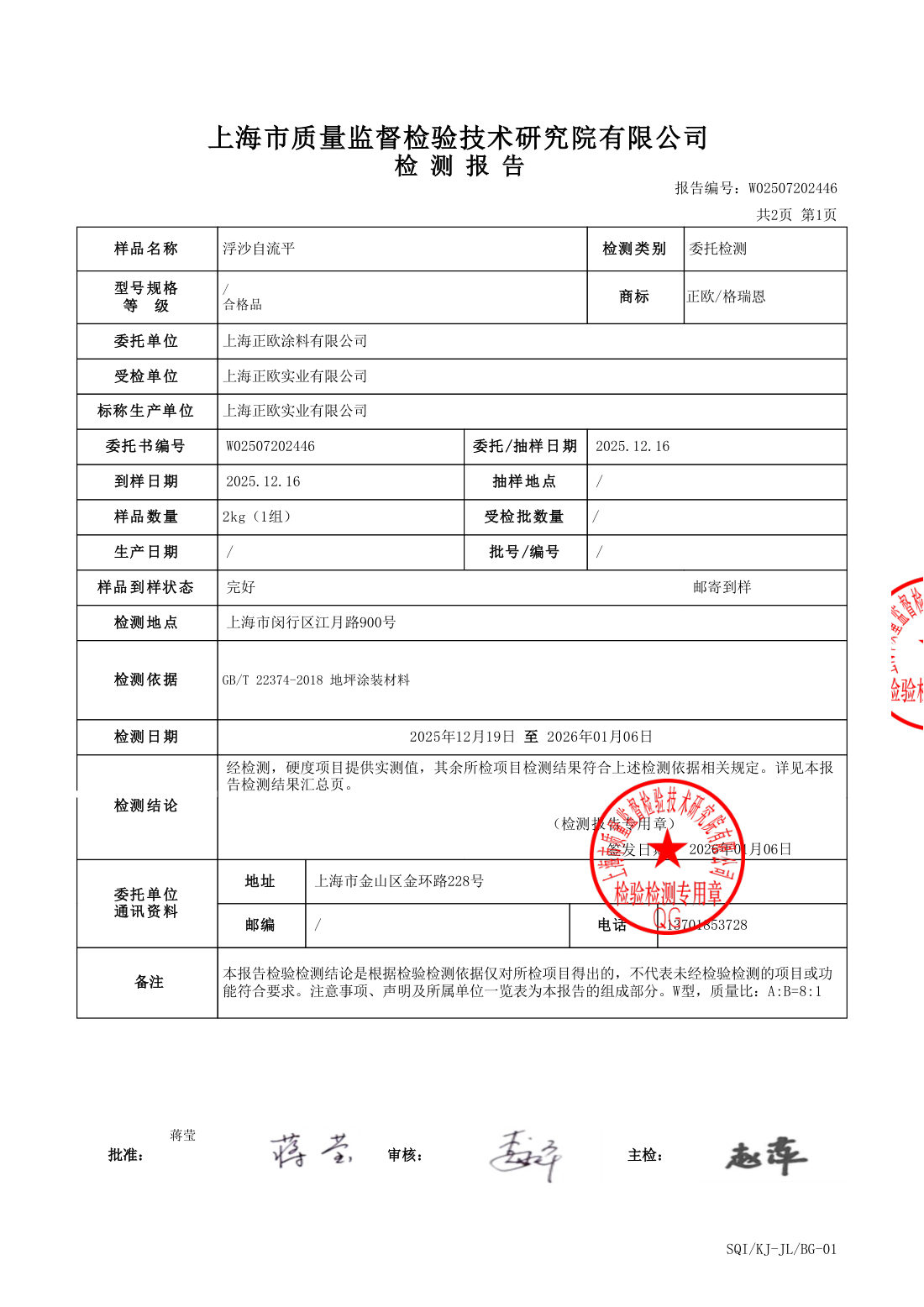
The conclusion, verbatim in spirit. Hardness is reported as a measured value; all other tested items conform to the standard. The remarks section also records the mixing ratio — A : B = 8 : 1 by weight — which is why we can state it publicly.
The limits. A commission test on a submitted sample proves what that sample did. It is not batch surveillance, it is not a warranty, and it cannot be reproduced in part. For project-critical installations, ask us about third-party witness testing on your actual batch — we would rather prove it on your material than argue about a certificate.
More on verification: How to read a Chinese coating test report → · Certifications and testing →
11. Frequently Asked Questions
What is quartz epoxy flooring, in one sentence?
A seamless composite floor in which coloured quartz sand is locked into a self-levelling epoxy matrix and sealed — known in our catalogue as floating-sand epoxy self-levelling.
Is it the same as epoxy terrazzo?
No. Terrazzo uses marble or glass aggregate ground and polished flat; quartz epoxy uses quartz sand left textured under seal coats. The look is related, the labour and price are not.
How does it compare with plain self-levelling epoxy?
Plain epoxy is glossier, easier to clean, and better for audit-driven environments; quartz is more slip-resistant, more wear-hiding, more forgiving of imperfect slabs, and more decorative. The choice is texture versus gloss.
Is it slip-resistant?
Our tested system measured a 0.77 dry friction coefficient against a 0.50 requirement, and the texture is through the body rather than an applied additive. Wet-condition performance is a separate specification — ask for it where ramps and wash-down zones are involved.
How strong is it, really?
Tested to GB/T 22374-2018: 79 MPa compressive strength (standard requires ≥ 45), 0.010 g abrasion loss (allowance 0.030 g), 4.0 MPa dry bond strength holding 3.9 MPa after water immersion. The full table with context is in Section 3.
What is the mixing ratio?
A : B = 8 : 1 by weight, as recorded in test report W02507202446. Weigh the components; the two parts do not share a density, so volume measuring is a silent error.
Can it be applied over an existing floor?
Over sound, well-adhered existing coatings, usually yes after mechanical preparation and adhesion testing. Over tiles, no. Moving structural cracks must be treated first — the floor will inherit them otherwise.
Can it be used outdoors?
Not as an exposed top surface. Epoxy yellows under sustained UV. Enclosed spaces are fine; open decks need a UV-stable topcoat system.
How do I clean it?
Neutral-pH detergent, dust-mopping and scheduled auto-scrubbing; periodic mechanical brushing keeps the texture clear. Slightly more attention than mirror epoxy, in exchange for a floor that hides wear between cleans.
What documents should come with an order?
Technical data sheet, safety data sheet in export format, the performance report (GB/T 22374-2018) for this product, a harmful-substance report, transport identification and a batch certificate. Check that every report names the same product you are buying.
12. Request a System Specification
Send us the brief and we will come back with an engineering answer, not a catalogue:
- Country, site type and the environment the floor will serve
- Area, new-build or renovation, and the slab's as-found condition
- Traffic: pedestrians, forklifts, vehicles, point loads
- Appearance intent: colour direction, gloss expectation, transitions
- Any compliance regime (HACCP, slip requirements, fire ratings)
- Programme and the documentation your tender requires
You will receive a proposed build-up with the reasoning shown, the current TDS and SDS, and the full test documentation for this system — including the limits of what the reports cover.
ZHENG'OU Floor Material — resin flooring manufacturer since 2002, exporting to more than thirty countries. National "Little Giant" specialised and sophisticated enterprise. Performance testing to GB/T 22374-2018 by an CNAS-accredited national institute.